Pragmatic Hope: Why Sustainability Isn’t a Lost Cause
This article is written by Sonali Deshpande, a WES 2026 student journalist and writer for The Boar.
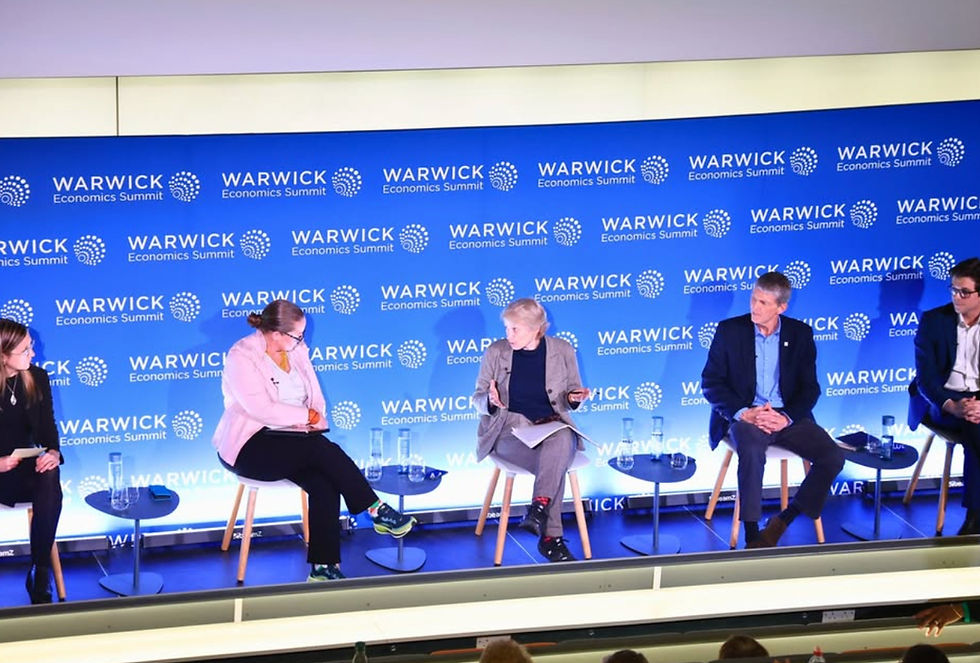
At a Warwick Economics Summit panel titled “Is Our Planet for Sale?”, the atmosphere could easily have tipped into despair. Climate discussions often do. Yet, it ended on something more grounded: pragmatic hope.
Valerie Hickey, Director for Environment at the World Bank, positioned herself as ‘bullish’ and ‘hopeful’ regarding the climate, something that felt rebellious compared to the others. In fact, a speaker mentioned how her hope felt refreshing compared to his typical perspective. Too often, sustainability debates are trapped between two opposites: apocalyptic pessimism or uncompromising idealism. The consensus seems to be that the system is irredeemably broken, or a total transformation is the only way to survive. Yet, Hickey’s argument cut through both. The climate transition will be messy and imperfect. We need to recognise that waiting for a flawless global coordination or perfectly designed system will just cause paralysis. And paralysis is incredibly expensive.
What I want to emphasise is that hope is not blind optimism. It is the recognition that progress is possible, even if it is imperfect. It is recognising that carbon pricing mechanisms may not capture every externality, ESG frameworks may be inconsistent, and transitional fuels may be controversial. However, rejecting them outright because they are incomplete ignores how structural change actually happens: through iteration.
Hickey spoke about ‘how debt should not be treated as a dirty word’ if it finances sustainability. Governments borrow in wartime. They borrow in financial crises. They borrowed at historic levels during COVID. Yet climate spending is framed as indulgent or reckless. Instead, it should be viewed as cost-efficient in the long term. Investment in sustainability, like renewable infrastructure or flood defences, is forward-facing risk management. Refusing to borrow for the climate today will shift greater burdens onto future generations through disaster recovery, health costs and economic disruption. If the threat is structural, the response must be structural too.
There are already examples of pragmatic hope taking shape.
Scotland has legally binding climate targets, aiming for net-zero emissions by 2045, earlier than the broader UK commitment. The country has invested heavily in wind power, with renewables generating a significant share of its electricity. The transition is not seamless; debates around oil and gas, grid capacity and heating remain unresolved. But legislation anchors direction. It signals to investors, businesses and households that the trajectory is set. That clarity matters. Markets respond to signals, and binding targets reduce uncertainty.
Switzerland shows how climate policy can be put directly to voters through referendums. Not every proposal gets approved, and policies are often reshaped along the way. However, this builds trust. When measures do pass, they tend to last because they’ve already faced public scrutiny. In this sense, sustainability isn’t handed down from above; it’s worked through collectively. And it suggests that tools like carbon pricing don’t have to clash with democracy; they can develop alongside it.
Dean Cooper, WWF, when asked about the inability of research to find sustainable solutions, drew a parallel with COVID. He pointed to how just because we do not currently have the solution does not mean we cannot develop one quickly. The vaccine rollout was faster than anyone had expected. Urgency accelerates global coordination and innovation. Climate technologies, from battery storage to green hydrogen, may feel slow-moving now. But history suggests that once incentives shift decisively, systems can move with startling speed.
The planet is not inevitably “for sale” if the rules of the market are structured to protect it. Debt is not inherently irresponsible if it funds resilience. Imperfect solutions are not betrayals if they create momentum. The danger lies less in flawed tools than in waiting for flawless ones.
Hickey’s reminder to ‘not let the perfect be the enemy of the good enough’ is what stayed with me most. It captures the fact that pragmatic hope may not sound as stirring as revolutionary ideas. But it has something more powerful: a track record.
The views and opinions expressed in this article belong solely to the writer and do not necessarily reflect the views and opinions of the Warwick Economics Summit.
Reference List


Comments